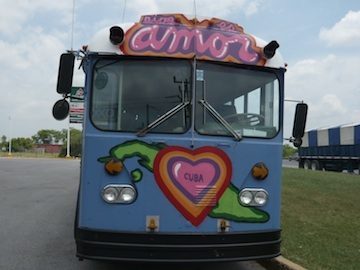
Monday, June 10, 2013

Changes in Cuba and the Caravan; same old blockade


Changes in Cuba and the Caravan; same old blockade

The 24th Pastors for Peace Caravan to Cuba will leave the US on July 16th, bound for Cuba.  This is an ongoing struggle against the illegal, immoral US blockade of Cuba, which uses denial of essentials like medicine and pacemakers as a political weapon, and it is a struggle we must win, not only for the sake of Cuba, but for our own sakes, so that, at least in this case, we can stop being responsible for deliberately causing suffering.

As people of conscience, we travel to Cuba as an act of conscious civil disobedience.  We are protesting both the blockade and the US government's restriction of travel to Cuba.  What is it we aren't supposed to go there and see?

Cuba is a process, not a fixed result.  We've been taught to think of socialist countries as stagnant bureaucracies.  There may have been some truth to this idea applied to Central Europe, but not to Cuba - it is the most innovative country in the world at this time.  This isn't just my opinion: Cuba was the only nation in the world that meets the Worldwide Fund for Nature's definition of sustainable development, for example.  Cuba's achievements in literacy, education, and health care are well known. Their biotechnology innovations are also widely recognized. They have managed some remarkable work-arounds to deal with restrictions and shortages caused by the blockade. They have developed methods of agriculture, including urban gardens, which are innovative, organic, and use human and animal power to limit the need for fossil fuels; and their transportation alternatives include the usual buses, but also bicycle and horse-drawn transport.  They have developed a system of representation which starts with elected delegates from the school, workplace and neighborhood level, and which eliminates the power of money in politics.

Does this all work perfectly?  Of course not.  Cuba has had a number of wrong and failed policies.  What is remarkable is that the Cubans have been able to recognize this and change things. Cuba and its revolution are in a continuing process of re-invention, and this is very obvious in regard to the attitude toward religion. Many people do not know that there are churches in Cuba. The churches are packed and there is no discouragement of religion.  The initial Soviet-style anti-religion hostility has been reversed.  The Cubans are pleased to be able to love both the church and the revolution without contradiction.
 Ebenezer Baptist Church, in Marianao, Havana
 A Catholic church in the same neighborhood

 The Martin Luther King Center is associated with Ebenezer Baptist Church.
 This poster hangs in a Baptist Church office: HUmanity is diversity; Campaign against homophobia.
 The youth choir
 For over half of all religious Cubans, Santería is part of religious belief.


Another obvious change shows in attitudes regarding homosexuality and sexuality in general, also quite influenced by Soviet attitudes previously.  There is no official stigma attached to sexual differences, there is an official anti-homophobia campaign, AIDS patients are not quarantined. A Cenesex (the official government department having to do with issues of sexual preference and sexuality) worker introduced us to the concept of LGBTH, in which H is heterosexuals, just another choice in the mix.
POSTERS FROM A BUS STATION IN SANTA CLARA

The worst symptom of AIDS is loneliness.  YOU CAN CARE FOR THIS.
Solidarity with people who live with AIDS has no boundaries.

Another recent change is the encouragement of more self-employment.  This is still a work in progress with an unclear future and self-employment is very small scale, but those who want Cuba to become a capitalist economy open to foreign exploitation are going to be disappointed.  Most Cubans, not all, and some US visitors, again not all, understand that the standard of comparison for Cuba may not be upper-middle-class US life but rather that of other Caribbean nations, which make Cuba look very good indeed.

TYPICAL SMALL-SCALE SELF EMPLOYMENT EFFORTS
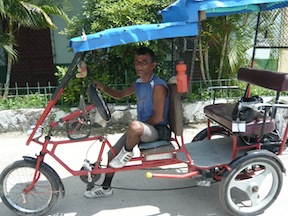
 Reynaldo, with his bicitaxi, which has, in addition to the customized steering wheel, mascots, water bottle, awning and a boom-box
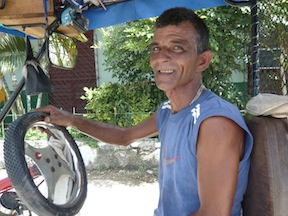
 Zaida, with a friend; in the background there is a fruitstand.
 A lot of sidewalk stands sell various goods, some of them junk.
The cotton candy stand at a carnival in Yaguajay
 There are many sidewalk take-out cafes operated from the front of people's homes.  This is a typical menu board.

This young cabinet-maker works from his back yard.

A note:  there are millions of working children in the world.  Not one of them is Cuban.

In the past year the requirement for exit visas for travel from Cuba was eliminated.  Cubans now have more legal freedom to travel than US citizens, who are prohibited by the US government from going to Cuba without special license.
No restrictions are placed on US citizens' travel by the Cuban government.  There is no requirement to stay with a group or to be accompanied or monitored in any way.  You can travel freely throughout the island.

The Caravan this year will be organized differently.  We will still send the message that the blockade is immoral and unacceptable and must be lifted.  We will still take aid to Cuba - medications and other portable aid carried in our baggage.  There will be no bus routes; we will gather in cities across North America during Cuba Caravan Week, July 8 - 15.  The event in Fresno will be July 12 at 6:30, potluck, music, and speaker, at College Community Congregational Church 5550 N. Fresno between Bullard and Barstow.
Caravanistas from Fresno will then participate in a major event in the Bay Area on July 15, fly to Mexico City for orientation, and then to Santiago de Cuba.

Santiago is a wonderful city, located on hills above a harbor like a little San Francisco, but founded in 1515.
 I was there in 2010 and it was remarkable for the friendliness of the people, their revolutionary spirit, and the vibrant music scene. It was the cradle of the revolution, where the attack on the Moncada Army Barracks took place.  We'll be able to celebrate the 60th anniversary of the start of the Revolution on July 26.

Santiago suffered very serious damage in Hurricane Sandy, which devastated eastern Cuba.  More than 130,000 homes were lost along with schools, hospitals and other infrastructure; crops were totally destroyed.  We will work with our Cuban partners to help reconstruct homes and buildings.  It's a different Caravan, and a very exciting change.  If you can't go with us, be sure to be there for our send-off on July 12, 6:30 PM, at College Community Congregational Church 5550 N. Fresno between Bullard and Barstow, and for our report-back afterward, when we'll tell you all about it.

And please, go see for yourself.  If you do not wish to engage in civil disobedience or "illegal" (does the government have the right to tell you where you can travel?) personal travel, seek out a licensed cultural exchange tour.  But go check it out.  Cuba has many problems, but Cubans are innovative, vibrant, educated, and friendly and they are in the process of constructing a working alternative to corporate capitalism.  It's worth seeing.

Sunday, April 8, 2012

photos from 2011 caravan

I- 5 bus

orientation


fixing the bus

security


press conference

border crossing training


through Mexico

The first event in Havana is the graduation of the Latin American School of Medicine.  American students from poor families can study medicine for free with students from many other countries.  After graduation they return to the US to practice in
"underserved areas." ELAM graduate with Tom Smith


ELAM graduates

diploma!
doctoras
Childrens' theater La Colmenita in Havana

El Malagon - veteran of one of the first organized militias in Cuba

In Pinar del Rio, we stayed in a rural church

Dancing in Pinar

Being short of sleep can be the hardest part of the Caravan


Luis Barrios, now one of the Co-leaders of IFCO, with Cuban translators

We met with the local chapter of the Cuban Women's Federation.  Maria Estrella is the oldest member.

We asked the group of women, "What do you you do if a man is hitting his wife?"  "Well," they said, "We ALL go to their house..."
They said that Cuban men have changed greatly in the past 10 or 15 years and that now there are many men who help with household tasks, cooking, and children

Pinar is full of limestone cliffs and caves

Anayanci is the head of the local Young Communists.  She was puzzled by our lack of a young communist section but spent time with our group anyway.

Water buffalo are less likely to need unavailable spare parts than tractors are.  Anayanci does not normally ride them; I dared her.


The meat eating table

the vegetarian/vegan table
On our return to Havana, we attended a racism conference and cultural event at the African Museum
The whole world owes a debt to Africa and only Cuba has begun to pay back.  The apartheid government could have lasted many years more without for Cuban help in defeating South African mercenaries in Angola.

Eleggua abre el camino

Lucius Walker's plaque was added to this monument just below Harriet Tubman's.


A caravanista fell, struck his head and had a seizure.  He was taken to Cira Garcia Hospital, where blood work, head CT, EKG, Neurologist exam (on a Saturday) and medications were given.  The cost was $0.00.

Improved after treatment.  Ojore asked me to translate to the hospital staff his exact words,  "Thank you, thank, thank you a million times.  There is no way a poor Black man could get this kind of treatment in the United States."

We prepare to cross the border back into the US, and the border officials prepare for us.  P4P means Pastors for Peace, of course.


A number of computers were confiscated on leaving the US this year and last year also.   This year they were returned to us on re-entering, since we can't take them to Cuba, and after all they ARE ours.

But we carried them all across the International Bridge into Mexico, where our Mexican companeros drove them to Tampico in time to join the rest of the aid shipment.

Sunday, August 21, 2011

Frequently Asked Questions


Frequently asked Questions

WHAT IS IFCO PASTORS FOR PEACE?
The Interreligious Foundation for Community Organization started Pastors for Peace after a study delegation was on a ferryboat in Nicaragua, along with 200 Nicaraguan civilians, when the ferry was attacked by Contra forces recruited and armed by the US government.  Two people were killed and 29 wounded, including IFCO Director Lucius Walker.

The aims of Pastors for Peace are:
To deliver material aid to support the victims of "low intensity" war in Latin America.
To offer this aid as solidarity, not charity.
To campaign for a more just and moral US foreign policy in our hemisphere.


WHAT IS A PASTORS FOR PEACE CARAVAN?
People coming together to demonstrate and enact an alternative foreign policy, an endeavor of love rooted in social justice.  Caravans travel through Canada and the US collecting aid and giving information about the purpose of the trip.  More than 50 Pastors for Peace Caravans have gone to Mexico, Central America, and Cuba.

WHY TAKE AID TO CUBA?
The message of the Caravan is - end the US trade embargo.
The blockade is a violation of the most fundamental principles of humanity.  It is our duty as citizens and as human beings to oppose this policy and to help, in a small way, to alleviate some of the suffering caused by it.

WHAT KIND OF AID?
Primarily medical supplies and equipment, also educational supplies including computers, tools, bicycles, and cultural supplies, also the school buses we travel in.  Wheelchairs are especially needed.

WHO DISTRIBUTES THE AID?
An ecumenical Distribution Committee made up of pastors and leaders of various denominations and religious organizations in Cuba receives and distributes the aid.

IS THIS LEGAL?
We travel to Cuba as a conscious act of civil disobedience and as a challenge to the US government's cruel and immoral blockade of Cuba, a blockade which uses the denial of food and medicine as a political weapon..  By taking a moral stand and openly challenging the blockade, we urge the US people and government to change this law.  That is why the Pastors for Peace Caravan is important.  Not so much because of the aid we take, though that is significant and needed, but because it is a statement, "I'm sorry that my government is trying to starve and deprive people to force them to give up their efforts to make a better society.  I disagree and I'm trying to change that policy." 


Saturday, August 20, 2011

22nd Caravan

Love is Our License
The 22nd Pastors for Peace Caravan to Cuba - See the Photos from the 2011 Caravan on this blog.

We were about 100 people, mostly from Canada and the US, later to be joined by about 12 Mexican companeros, in 12 buses, traveling routes throughout Canada and the US, visiting 130 cities picking up aid and participants and talking about our mission of solidarity with the Cuban people and defiance of the US law prohibiting travel to Cuba.  Heat, hard work, long hours, and difficulty at the borders were just what we expected, but the special challenge of this Caravan is that Pastors for Peace founder and leader Lucius Walker died shortly after the Caravan last year.  It became very clear that the organization is far more than even the best, most charismatic leader (just as the Cuban nation is) as this year's Caravan delivered 100 tons of aid and masses of human solidarity to the docks of Tampico for shipment to Cuba.

The buses converge in McAllen Texas, where we trained for non-violent civil disobedience; unloaded, packed and invoiced, and reloaded all the aid; formed affinity groups and work teams; repaired buses; and learned about the Pastors for Peace and about Cuba.  Kitchen teams worked about 16 hours a day in shifts and security shifts  we shared round the clock kept us and the buses safe from harm.  (Violence and sabotage from those opposed to the Cuban revolution is a real threat both here and in Cuba.  In my personal experience a bus had its windshield smashed when a church security guard along the route failed to arrive and we were not aware of the problem.)  If you are getting the idea that this is not a tropical vacation, well...

The border crossing from the US to Mexico is a double crossing, for the US border authorities take a great interest in our exit, attempt to inspect our cargos and seize aid.  This year it was 7 computers which were taken.  Then we enter Mexico, which had historically been noted only for meticulous inspection of our boxes and invoices, but where, in the past 2 years, Mexican border authorities, we suppose in cooperation with the US government's wishes, have been harassing the caravan by pretending to regard us as a commercial enterprise rather than as humanitarian aid, and requiring payments.  This year our Mexican comrades helped organize a demonstration inside the office of the  Border Supervisor.  It seems the Caravan always wins by being more determined, more enduring, and louder than the opposition. Onward we went, through Reynosa, and along the highway to Tampico, with a few pauses for bus repair.  We loaded all the aid into shipping containers,  ate dinner at 3AM, slept a few hours and got into a plane which landed us in Havana.

Our first event was a welcome at the Museo de Bellas Artes, where a curator took us through exhibits of Cuban art of the last 5 decades.  The flourishing of culture during the years since the revolution is impressive, as is the fact that there's no "socialist realism" here - content and styles are wildly varied.  Next in Havana is an event which every year moves me to tears: the graduation of the Latin American School of Medicine.  These students, who come from all over the world, including the US, to study medicine for 6 years, with plans to return to their own communities to practice medicine for poor people for the rest of their careers, actually carry out these plans.  In Cuba they learn not only family, community, and disaster medicine, but internationalism, practical idealism, and cooperation.

On Sunday most of us, even the atheists, went to church.  I went to Ebenezer Baptist, part of the Martin Luther King Center in Marianao, a working class section of Havana, where we were received with enormous warmth.  Cubans kiss each other on the cheek in greeting and my cheeks were thoroughly kissed.  The early days of the revolution were anti-religious, in part because the Catholic Church then served as a counter-revolutionary center, even circulating the false rumor of children being taken from their parents to be raised by the state - a rumor which led to the family tragedies of Operation Peter Pan.  Both the church and the revolution have changed; the church no longer works against the Cuban people and there is no government hostility toward religion at all.  It is interesting and unique to Cuba to meet devout evangelicals who are also devout Communists.

We then went in 3 groups to different provinces.  I went to Pinar del Rio, to a rural area where we helped transplant 500 banana trees; played volleyball, chess, soccer, and swam with our Cuban companeros; had interactive meetings with youth groups and Federation of Cuban Women members including an elderly woman who was blind in one eye from a childhood injury for which no medical care was then obtainable, and who was not shy about telling us her life and opinions; learned about the formation of Cuban militias to combat counter-revolutionary violence and met the last surviving member of the first self-organized group; celebrated the 26th of July at a small but lively settlement; toured a cave, and petted a one ton water buffalo - as strong as a tractor and spare parts are not a problem.  This was especially notable as the mechanics in our group were helping the Cubans repair a tractor for which the soviet parts were unobtainable.

Returning to Havana, we visited the Latin American School of Medicine, and the Center for Biotechnology.  The Cuban medical system needs its own article, which I'll try to provide soon.  We went to conferences about youth in education and medicine, about US Cuban relations,  about gender and family issues,  and  about the Cuban economy and planned changes - a  planning process which involved almost the entire adult Cuban population. We saw a performance of children's musical theater and  other musical performances. We went to events honoring Lucius Walker who is a great hero in Cuba as he is to all of us who knew him. We went to Casa Africa for discussion of race and racism and were shown art and religious artifacts.  Again this year we met with relatives of the five Cuban heroes who are imprisoned in the US after they attempted to investigate Miami-based anti-Cuban terrorism.  They are known in the US as the Cuban 5. This is another subject which needs its own article - coming soon.

I missed the last big event - honoring Lucius  Walker - because a Caravanista needed emergency medical care.  Details in the Cuban medical system article!

We flew back to Tampico, rolled through Mexico, and recrossed the border.  After a few hours of  US border official harassment of one Caravanista, a former political prisoner,   we all returned to the US.  Our seized computers were then returned and we turned right around and we walked them back across the international bridge into the arms of our Mexican companeros who will get them to Tampico in time to ship with the rest of the aid.  The Cubans will never give up and neither will we.  A better world is possible.  
Aqui nadie se rinde.  Un mundo mejor es posible.

SEE PHOTOS FROM 2011 CARAVAN ON THIS BLOG.